
BUILDING ENTERPRISE VALUE AND EXIT READINESS FOR FOUNDER-LED COMPANIES
More than advice
- True partnership
FOR FOUNDERS WITH $1M – $10M EBITDA EXIT WINDOW: 12 – 36 MONTHS
Two founders sell the same business…
ONE WALKS AWAY WITH
$40M
ONE WALKS AWAY WITH
$25M

The gap is not luck. It is preparation.
I work with founder-led companies between $1M and $10M in EBITDA, 12 to 36 months from a sale. A great exit is built over years, not won at the table.
Most founders only get one chance to sell.
Four common problems leave value on the table long before a sale begins.
A number they can't defend
Without normalized financials and a defensible add-back schedule, buyers discount every favorable number they can't verify. Each soft number becomes a lever, on price, on terms, on the holdback.
Revenue they can't rely on
Customer concentration hides real risk. Margins swing from quarter to quarter. Growth has no repeatable cause. Buyers cannot underwrite revenue they cannot model with confidence.
A business still dependent on the founder
Key customer relationships, pricing decisions, and major operating calls still run through the founder. Buyers discount value when too much of the business depends on one person.
Diligence exposes the gaps
Processes are not fully documented. Reporting is inconsistent. Accountability is unclear. Buyers pay more when they can quickly understand the business, verify how it operates, and see how it transfers.
A buyer is not buying your business.
They are buying three things - and every diligence question sorts into one of them.

Predictable cash flow they can underwrite.
Customer concentration. Recurring revenue. Margin stability across cycles. The buyer is solving a single question: if nothing changes and I lever this business, does the debt service work?

Scalability they can finance.
Systems and process that survive the founder leaving the room. A management layer with depth. Documented workflows. Technology that scales without proportional headcount.

An exit they can plan.
Sophisticated buyers are already thinking about the next owner. Growth runway, market position, and a credible path to greater value shape both what they can pay today and what they can realize later.

PHASE 01
Baseline, Valuation & Roadmap
I start with the numbers and the gaps. Normalized EBITDA, add-back analysis, market comp review, and a preliminary valuation range. From there, an exit readiness assessment surfaces every financial, operational, and structural gap suppressing your multiple — and a prioritized, time-bound roadmap for closing them. You leave Phase 01 knowing exactly where you stand and exactly what is getting fixed, in what order.
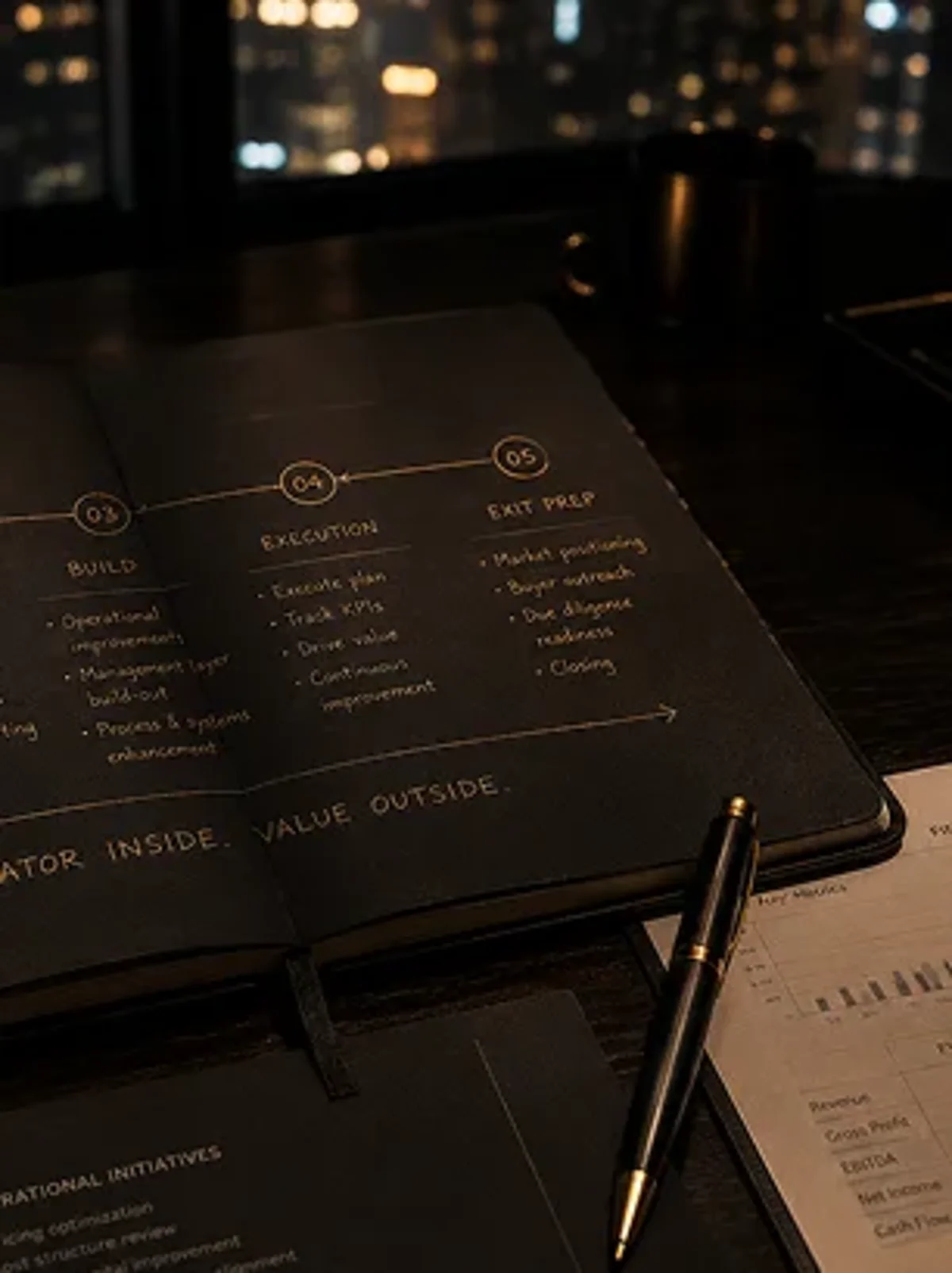
PHASE 02
Value Creation Execution
I do the work. The roadmap from Phase 01 becomes a sequenced execution plan, and I run it alongside you — financial cleanup, growth initiatives, operational documentation, management layer build-out, and structural fixes. Specialists from a curated network are pulled in only when the work demands it. You get an operator on the inside, not a report and a referral list.

PHASE 03
Exit Positioning & Go-to-Market Readiness
I construct the narrative, define your buyer universe, and prepare you to arrive at market with clean financials, a defensible story, and a management team that can survive diligence.

Operator, not just advisor.
Most exit advisors have never run a P&L. I have built and scaled businesses across technology, financial services, automotive, and real estate, with exits along the way.

Execution partner, not deliverables.
Most firms hand you a report and a referral list. I quarterback execution alongside you, doing the work directly and bringing in a curated network of specialists across finance, marketing, and AI only when the engagement calls for it.

Aligned incentives. No success fees.
Most exit advisors only get paid if you sell. I get paid for the work — which means if the right answer is "do not sell yet," I will tell you. The goal is your outcome, not closing a transaction.


A small number of clients at any given time.
By design.
Shaaya Sharifi
Founder, Isle Ventures
I am an operator who thinks like an investor, and I have been on both sides of the table.
INVESTOR
I learned how buyers underwrite, price, and pull a business apart — across private equity, institutional real estate, and credit.
OPERATOR
I led sales and go-to-market at venture-backed technology startups, and ran strategy, transformation, and BD at scale at AAA.
BUILDER
I grew businesses from zero to one and scaled them from one to ten, including AAA's GoMentum Station to a successful exit.
ADVISOR
I built and led the Orange County and Los Angeles practice of a boutique M&A advisory firm, advising on exit readiness, value creation, and M&A transactions.
Today,
At Isle Ventures, I guide founder-led companies through their most important inflection points.
Most M&A advisors have only sold companies. Most consultants have never operated. Most operators have never invested. The work is in the combination.
Advises Haize Labs and Berkeley SkyDeck. · BA Economics, UCLA. MBA, UC Berkeley Haas.


What Founders Say
Every engagement is different, but the outcome is the same: better preparation, stronger positioning, and greater confidence at the table.
Tyler Watkins - Owner, OCIP